
Why Use an Airless Paint Sprayer
Updated: Aug 7, 2025
Artificial spraying has a long history. With the progress of time and the development of science and technology, spraying technology has been constantly innovated and upgraded. In today's coating industry, airless spraying has become one of the most popular and widely used coating methods.
Today, let's take a deeper look at the principles and advantages of airless spraying. By reading this article, you will understand the components of an airless paint sprayer as well as the range of applications. From these two aspects, you will understand why airless spraying is the best choice for you.

Composition of Airless Paint Sprayer
Airless spraying equipment generally consists of power source, high pressure pump, pressure storage filter, high pressure hose for paint delivery, paint container and spray gun.
(1)Power source:
The power source of high pressure pump is driven by compressed air, electric power and engine machine.
(2)Spray gun:
Airless spray gun consists of gun body, tip, filter, trigger, gasket and connecting parts. Airless spray gun only paint channel, no compressed air channel, and requires the paint channel has excellent sealing and high pressure resistance, to ensure that there is no leakage of pressurized high-pressure paint.
There are various types of airless spray guns, including hand-held spray guns, hand-held long-rod spray guns and automatic spray guns. Hand-held guns are lightweight and easy to operate, and are suitable for a wide range of airless spraying operations in both fixed and unfixed locations. hand-held Long rod spray gun gun rod length of 0.5m to 2m, the front end of the gun has a rotary mechanism, can be rotated 90 °, suitable for tall workpiece spraying. The opening and closing of the automatic spray gun is controlled by the cylinder at the end of the gun, and the movement of the gun is automatically controlled by the special organization of the automatic line, which is suitable for the automatic spraying of the automatic coating line.
(3)High-pressure pumps:
High-pressure pumps are divided into double-acting type and single-acting type according to the working principle. According to the power source is divided into pneumatic, hydraulic and electric three kinds, pneumatic high-pressure pump is the most widely used. Pneumatic high-pressure pump powered by compressed air, air pressure is generally 0.4MPa to 0.6MPa, through the pressure reducing valve to adjust the compressed air pressure to control the pressure of the paint, paint pressure can be tens of times the pressure of compressed air input. The pressure ratios are 16:1, 23:1, 32:1, 45:1, 56:1, 65:1, etc., which are suitable for different varieties and viscosities of paints.
The biggest feature of pneumatic high-pressure pump is safety, simpler structure and easy operation, but its disadvantage is large gas consumption and large noise. Hydraulic high-pressure pump is powered by oil pressure, oil pressure up to 5MPa, with a pressure reducing valve to regulate the spraying pressure, hydraulic high-pressure pump is characterized by lower power consumption, low noise, the use of safety, but need a special oil pressure source. Electric high-pressure pumps are directly driven by electric current, easy to move, most suitable for unfixed spraying places, low cost and low noise.
(4)Pressure storage filter:
Usually storage pressure and filtering mechanism is combined into one, known as pressure storage filter. Pressure storage filter consists of barrel, filter, net frame, drain valve and paint valve. Its role is to stabilize the paint pressure, to avoid the high pressure pump plunger reciprocating movement to the conversion point caused by the instantaneous interruption of the paint output. Another role of the pressure accumulator filter is to filter out impurities in the paint to avoid tip clogging.
(5)Paint pipeline:
Paint pipeline is a high-pressure pump and spray gun between the paint channel, must be resistant to high pressure, resistant to paint erosion, pressure strength is generally 12MPa to 25MPa, should also have the function of eliminating static electricity. Paint pipeline construction is divided into three layers, the innermost layer of nylon tube blank, the middle layer of stainless steel wire or chemical fiber woven mesh, the outer layer of nylon, polyurethane or polyethylene, but also must be woven into the grounding wire, for spraying grounding.
As you can see above, airless sprayers are exquisitely complex. And slightly different types of machines are developed for different scenarios. This also shows that airless sprayers are applicable to a wide range of applications.
Next, let's learn more about the scope of application of airless sprayers.
Wide range of applications
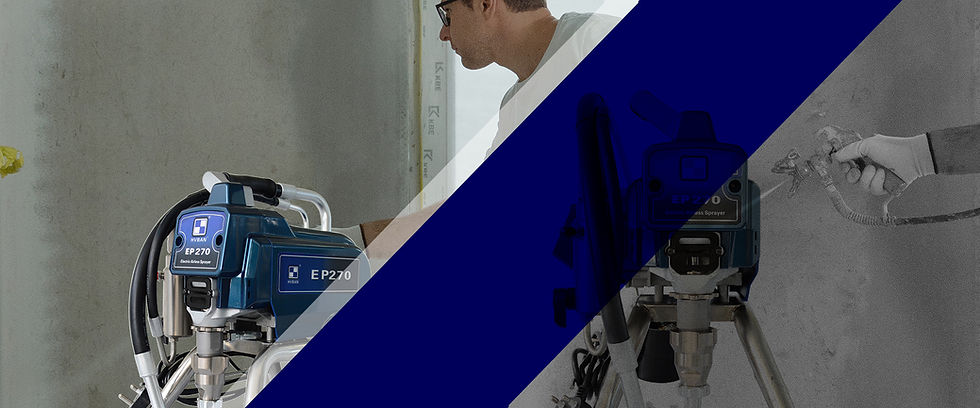
Airless spraying has a wide range of applications, which are explained below:
Industry
| Spraying area | Applicable Coating Type |
Shipbuilding |
Bilge shell plate ballast water tanks water tanks passenger compartment cargo hold
| Anti-corrosion coatings ship bottom coatings |
Constructions |
Interior and exterior walls floors steel beams roof surfaces
| Oil-based and water-based coatings waterproof coatings soundproof and fireproof coatings anti-rust coatings |
Steel industry |
Marine thick steel plate
| Inorganic zinc-rich Epoxy iron red Anti-corrosion coating Agentable Coatings |
Automotive industry |
Inner shell chassis
| Polyurethane primers topcoats anti-stoning coatings damping coatings |
Transportation civil engineering |
Bridges steel piles docks buses trucks locomotives pavements road signs subways
| Anti-corrosion soundproofing anti-skid coating anti-corrosion waterproof coating road marking paint |
Chemical industry |
Piping equipment
| Explosion-proof paint (two-fluid type) antirust paint outdoor paint |
Appliances |
Household appliances transformers
| Anti-corrosion anti-corrosion and decorative coatings |
Furniture |
Steel wood
| Nitro Polyurethane Epoxy Coatings |
Operating machine |
Casting and forging components
| Epoxy epoxy asphalt coating (two liquid type) |
Gas water |
Water pipes underground gas pipes
| Anti-corrosion coatings (two-liquid type) |
Aviation industry |
Airplanes helicopters
| Antirust coatings decorative rubber coatings heat-insulating and fire-retardant coatings |
Airless sprayers are used in a wide range of applications, so you need to select specific equipment based on your needs. The following are three main selection criteria:
Selection according to the characteristics of the coating: first of all, the viscosity of the coating should be considered. For high viscosity, difficult to atomize the paint, should choose high pressure ratio or equipped with heating system equipment. For two-component coatings, water-based coatings, zinc-rich coatings and other special coatings, it is necessary to select a special model of equipment.
Selection according to the condition of coated workpiece and production batch: this is the main factor of equipment selection. For small workpieces or small batch, generally choose the model with smaller spraying volume; for large workpieces and large batch, such as ships, bridges, automobiles, continuous automatic coating lines, etc., choose the model with larger spraying volume. Usually, the paint spraying volume is less than 4L/min for small-sized, 4L/min to 11L/min for medium-sized, and more than 11L/min for large-sized.
According to the power source selection: general spraying workplace have compressed air source, in this case you can choose pneumatic airless spraying equipment. If there is no compressed air source but there is a power source, then you should choose electric airless spraying equipment. If there is neither air source nor power source, then you can choose engine-driven airless spraying equipment.
Please select the appropriate airless sprayer model based on the above criteria and your own needs.
Summarize the advantages
Through the above understanding and information access, we can summarize the advantages of airless sprayers:
Since there is no compressed air in the coating, the problems caused by moisture, oil and other impurities in the compressed air can be eliminated, and there will be no loss of coating due to the rebound of the compressed air on the surface of the coated object.
One-time spraying can obtain high film thickness. Airless sprayer is suitable for spraying all kinds of high solid, thick film type of heavy duty anticorrosive coatings, one time spraying up to 300 μm film thickness, saving energy and reducing the number of times of spraying.
High spraying efficiency. The efficiency of airless spraying is 3 to 4 times faster than air spraying, and at least 10 times faster than traditional brushing or rolling. The fan width of airless spraying can reach 300 to 500mm, the spraying flow rate is 500 to 3000mL/min, which is especially suitable for large-area construction, and the spraying rate reaches 200 to 400 m²/h, which is very high in production efficiency.
Airless spraying can evenly coat paint on various surfaces, ensuring a smooth, high quality surface effect without brush marks or roll marks. Paint can be heated and sprayed without adding thinner to reduce paint viscosity and increase coating adhesion.
Versatility: Airless sprayers are ideally suited to a wide range of coatings and applications, for both indoor and outdoor tasks, and for complex surface treatments such as corners, edges and textured areas. Different types of surfaces such as narrow bins, tall equipment and buildings can be sprayed by choosing different guns and machines.
Deep penetration and adhesion: High-pressure spraying enables the paint to penetrate deeply into the pores and cracks of the surface, thus improving adhesion and extending the service life of the coating.
Airless spraying has a high utilization rate of paint and reduces the pollution of solvent-based paint to the environment.
It can be used for spraying various new types of heavy-duty anticorrosive coatings, such as epoxy resin coatings, polyurethane coatings, polyurea and other two-component coatings, to give full play to their excellent anticorrosive properties.
It is conducive to the realization of spraying automation and unmanned spraying and other operations.
Easy to use: Airless sprayers are designed to be friendly and reduce the difficulty of use. Both DIY enthusiasts and professionals can easily get started and obtain professional spraying results, making spraying possible for everyone.
Conclusion
To summarize, the airless sprayer equipment is well composed and has a very wide range of applications. Efficient, high quality, simple design and easy to operate, they are the preferred method for home renovation or professional spraying. Whichever your spraying needs are, an airless sprayer will provide excellent performance and results. If you need more information, please feel free to contact HVBAN and we will be happy to assist you.


Comments